Wednesday, November 29, 2017

Mock Science Experiment, Report, and Display Template


Let's Reverse Engineer the Process

 "to disassemble and examine or analyze 
in detail (a product or device) to discover 
the concepts involved in manufacture usually
 in order to produce something similar." - Merriam Webster

Using the mock experiment provided, let's look at the final project check sheet in reverse. I recommend that you find each area in the Science Fair Packet for definition, steps, and other information.


F. Bibliography (References) and E.  Acknowledgements/Credits 

Easy Bib

Google Doc (Citing Sources)

Use one or more of these tools to try Creating a Sample Bibliography with the Packet Recommended Sources. Also remember, to use the word Bibliography (center) at the top of the page.  Citations should be listed in alphabetical order by the first word.  

Selecting Sources Reminder(s)
Utilize a Recommended Database or Evaluate the Source (What #?)
http://fhsalmc.blogspot.com/2016/10/reliable-sources_17.html

E. Ideas for Future Research, Conclusion, Data Analysis and Discussion, Experimental Procedure, Materials List

Conclusion (Packet info.: Answer investigative question/prove or disprove hypothesis/ summarize and evaluate procedures/include supporting data/Explain how the data supports/suggest changes: procedures and/or possibilities for further study)

Plagiarism Reminder
"Some descriptions of plagiarism include cheating, using someone's else's work as your own, using someone's work inappropriately, and/or not giving credit to sources used."
Read More at: http://fhsalmc.blogspot.com/2017/10/


D. Background Research (Study your topic and become a scholar)

C. Abstract, Table and Contents, Questions, Variables, and Hypothesis

Introduction (Abstract, Question, Variables, and Hypothesis)


Question: (see the Science Fair Guide Checkpoint Planning Sheet and Defining the Terms)

Variables and Hypothesis:

B. Title Page

A. Selecting a Topic

1. Science Fair Experiments Examples
http://www.education.com/science-fair/ (see for ideas and possible sources)

http://www.sciencebuddies.org/science-fair-projects/project_ideas.shtml (see for ideas and possible sources; ask your teacher about preferences for this site)


https://drive.google.com/file/d/0B8EeKjxvOy9IN205dzItem5oZUE/view?usp=sharing (Book list at FHSA)

Consider using Wikipedia for ideas even if you don't use it as a main source.  Also, look at the sources in the selected Wikipedia article.

2. Creating an Original Science Project Idea
http://blogs.scientificamerican.com/guest-blog/3-strategies-for-an-original-science-fair-project/



Wednesday, November 15, 2017

Five Finger Test (Create Your Own with these in Mind) - Writing in the Library Media Center

Have you heard of the five finger test for choosing the right book?  If not, I have a few examples linked below.  Once you understand the five finger test, find a way to paraphrase or come up with your own test to find the right book.


http://www.bookadventure.com/book_finder/5_finger_test.aspx  (Suggests the middle of the book)

http://www.monroe.k12.tn.us/mis/library/five_finger_test.htm

http://www.scholastic.com/parents/resources/article/book-selection-tips/choose-books-right-reading-levels

Join the blog with your Little Rock School District email, XXX@students.lrsd.org (3rd-8th) and K-2, ask the media specialist.  After joining the blog, post your Five Finger Test as a comment.  If you have problems, see the media specialist.

Friday, November 10, 2017

Reading Goals 2017-18 and Reading Challenges


Current Reading Challenge 
(12 Weeks Beginning Nov. 29)


Reading Goals 2017-18


Reading and other school programs can be found at:

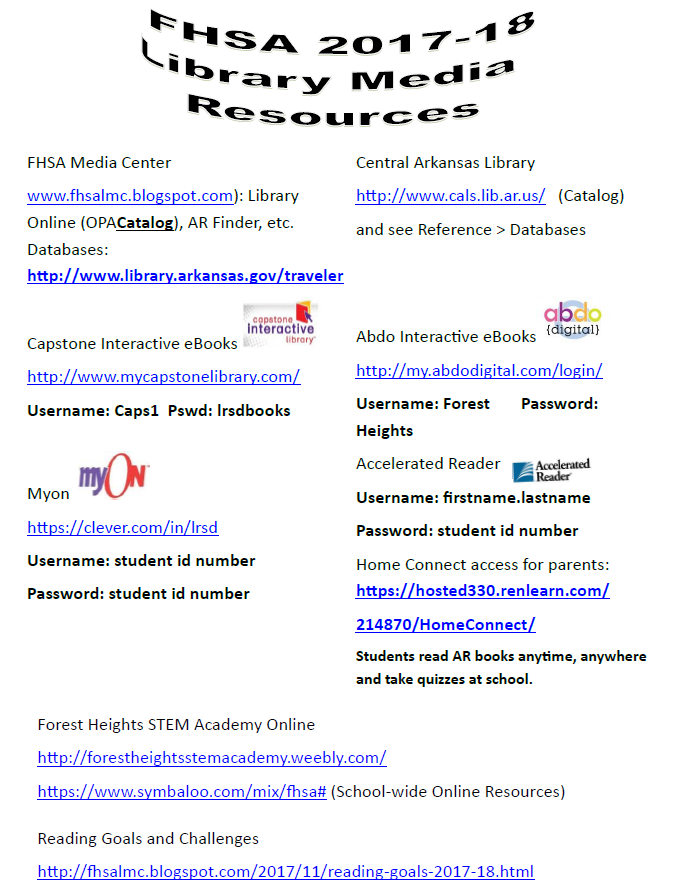
Myon Login Instructions: Go to the FHSA Symbaloo > Click Myon
> Login username: Student ID and Password: student ID

Accelerated Reader (quizzing at school only): Go the the FHSA Symbaloo >
Click Renaissance Learning >
Login Username: firstname.lastname and Password: Student ID

Accelerated Reader Book Finder

Monday, October 30, 2017

Plagiarism

Pre- Assessment
Review Library Procedures (Reminders: Sign-in location and an Adult must be present)


Pre-Assessment
TBA Answer Sheet and Pen/Pencil

 Introduction
What do these people have in common?

Justin Bieber
Tyler Perry
Cold Play
Nicki Minaj


Some descriptions of plagiarism include cheating, using someone's else's work as your own, using someone's work inappropriately, and/or not giving credit to sources used.

Essential Question
Throughout the rest of this lesson ask yourself, what is plagiarism and how does it relate to you as a student in the 21st century.

Share class answers at: https://docs.google.com/a/students.lrsd.org/forms/d/1VVIkvR8Tp0OikL2uUGgfpR3huJoonPpkzYbMMqFOjCc/viewform?c=0&w=1Please be advised that you will have a post-test over the information.  You should've taken the pre-test already (let your teacher know immediately if you have not).

Post Assessment


1. Go to the FHSA Symbaloo > Click Renaissance Learning > Login as user: firstname.lastname and pswd: id number (lunch).


2. Click Take a Quiz > Search for Avoiding Plagiarism> answer the questions and submit the quiz.


Resources

Fair Use (Using Content Legally)
http://education.ky.gov/districts/tech/ciits/Documents/TeacherCopyright_chart.pdf

Google Drive and Research Tools
https://support.google.com/docs/answer/2481802?hl=en

Easybib
 http://www.easybib.com/ (there is also an add on for Google Chrome)

Cite Fast
http://www.citefast.com/

Lesson Plan Notes:

Standard
SR.4.X.3 Respect and follow copyright laws 

Wednesday, October 25, 2017

Why Not Google? 5 Things Students Should Consider for Academic Research


Consider:

  1. There is a difference between search and research (see Myon book, Computer Search and Research). In addition, Google (and other free search engines) are designed for searching (often showing top searches for paid and/or popular sites) and academic and professional databases were designed for research (schools, libraries, and groups pay to have access to the information compiled by professionals and experts).

    "... Searching is the first step, when yo use a computer to find information. Research is the second step--looking at the information carefully, to decide whether it is useful."

  1. Current research projects are building a foundation for high school credit work, collegiate, and/or professional research. Aside from gaining knowledge about the topic, another purpose is to acquire research skills based on best practices that will save you time and help you to more likely obtain accurate information. With the Internet as a common tool, students often don’t have the skills to complete high level research observed often in college settings.  (Articles available, linked as handouts)

  1. Consider fair use of material (use of words, pictures, video and audio (example: 10 % of a song or no more than 30 sec), paraphrasing, quoting with limits (consider fair use and ask your teacher), and citing sources to avoid plagiarism. (ask your librarian).

  1. Using Google (or use another search engine) instead of going straight to an available library database (example: Proquest/eLibrary at FHSA OPAC Links: http://www.library.arkansas.gov/landing-page/details/databases-by-title), means you should master boolean operators (AND, OR, NEAR, NOT)  and other strategies.  Know that research is often not a quick activity.  With this in mind, quicker may still mean after a time of looking, reading, and trying different strategies that some professional may have already done for you in an available database.

  1. Choosing to Google (or use another search engine) instead of going straight to a professional or academic database (example CALS A-Z: https://www.cals.org/research/databases-atoz.aspx), requires using a teacher recommended plan to ensure you have reliable sources and consider that some professionals may have already saved you some steps/time in an available database..


Previous Post Addition (10.25.17)
Review Library Procedures
http://fhsalmc.blogspot.com/p/rules-and-procedures.html
(A few reminders and updates: 1- Be sure to sign in by the workroom door everytime you come into the library and are not with a class. 2- If for some reason there is no adult present in the library, you should return to class immediately (usually there will be a sign posted on the front door so look for it as well).


Handouts  (login to view draft)
https://docs.google.com/a/lrsd.org/document/d/18hmXV4hRkoS9-Fz_CMoV_FKohzeVQkKXOsBrheyS7Sw/edit?usp=sharing 

Challenge:
List some of your favorite sites for research and use the chart provided to see how well these sites score for credibility.

References 
Compiling...